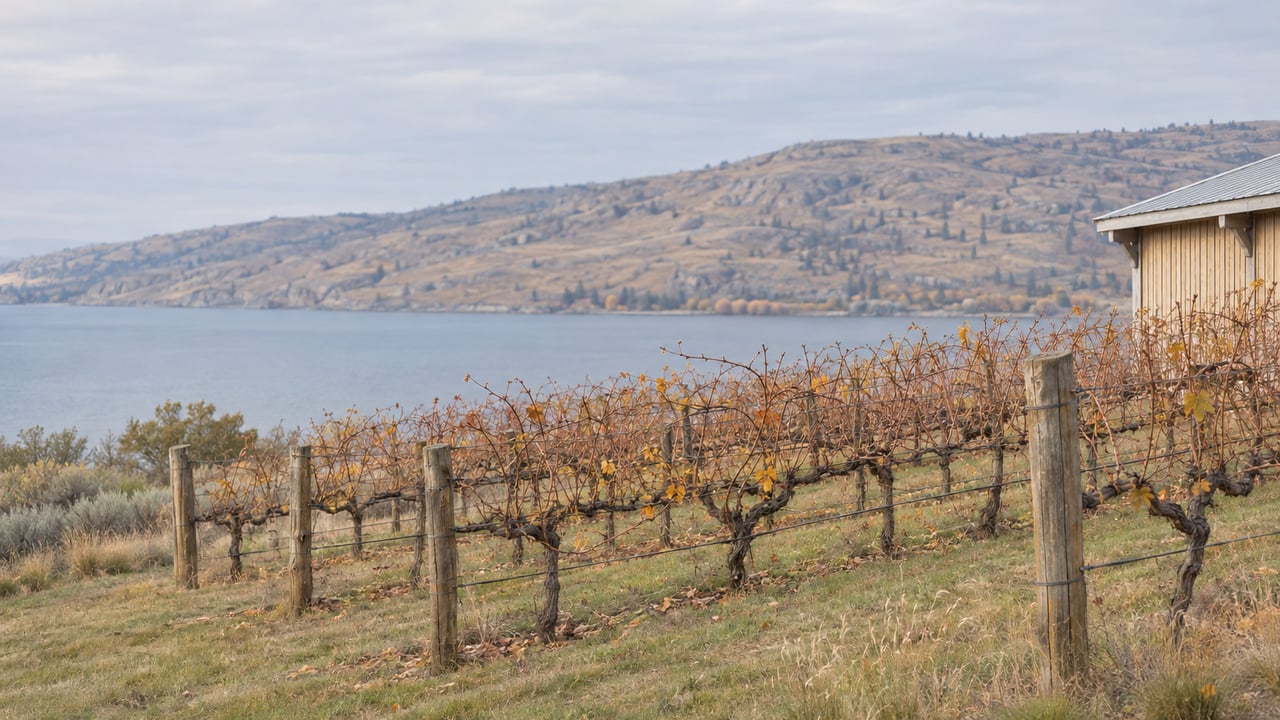
"14 tonnes of quality Merlot grapes from the Naramata Bench available. Clone 182/347. Professionally managed vineyard." That classified went up on the BC Wine Grape Council's board on September 29, 2026, in the middle of harvest. It listed no price.
The ad says a lot about the Bench acreages that come with a few acres of vines beside the house. The fruit was well farmed and the clones were named. Even so, a grower with a professional manager was still looking for a winery to buy those grapes as the 2026 crop came in. If you are comparing properties in Naramata Rural, the two facts that decide whether the rows pay their way are where the fruit went last fall and who has agreed to take it next year.
What a ton of Bench fruit paid in 2025
The latest full-year pricing comes from the BC Wine Grape Council's 2025 Annual Crop Assessment, which covers the 2025 vintage and took reports through May 15, 2026. For fruit bought in 2025, growers were paid an average of $3,722.07 per U.S. short ton for Pinot Noir, $3,511.59 for Merlot, $3,545.83 for Cabernet Franc and $3,884.54 for Cabernet Sauvignon. White varieties paid less over the same vintage, averaging $3,049.16 for Chardonnay, $2,776.59 for Pinot Gris and $2,724.90 for Riesling.
Those averages count only fruit that changed hands. The council's pricing tables leave out winery-owned and winery-leased vineyards, and they filter out unusually low and high prices. They describe what a buyer paid an independent grower. A homeowner's few acres are an independent grower.
The same report shows what this part of the valley grows. In 2025, the Penticton, Naramata and Kaleden region produced 3,919.52 short tons, 12.03% of the reported provincial crop. Pinot Noir led with 654.13 tons, followed by Merlot at 589.35 and Pinot Gris at 562.11. The council described 2025 as a year when crop levels returned to normal after a near-zero 2024. Most vineyards were still rebuilding trunks and cordons after the December 2022 and January 2024 cold events.
So the variety most likely to be growing beside a Bench home is the one that fetched the highest average among the area's leading grapes in 2025. In 2026, that was also the variety that ran into trouble.
Rough arithmetic for one planted acre
The council also publishes a financial planning model for establishing a vineyard. At year five, when the vines are in full production, it puts direct expenses at $11,019 per acre at a modeled yield of 5 tons per acre. That leaves a contribution margin of $3,981 per acre before overhead, interest and other fixed costs. The model calls itself a planning tool, not a cost-of-production study, and its figures are in 2023 dollars. Treat it as a rough guide, not a quote.
You can still do useful math with it. At the model's 5 tons per acre and the 2025 average Pinot Noir price, one acre grosses about $18,600. Merlot comes to about $17,550, Chardonnay about $15,250 and Pinot Gris about $13,900. Subtract the model's $11,019 in direct costs and an acre of Pinot Noir clears roughly $7,600. An acre of Pinot Gris clears under $2,900. Overhead, equipment and the owner's time all come out after that, and the margin assumes the full crop sells.
In October 2025, Castanet reported on an 11-acre Bench property at 1675 Midland Road listed for $25 million with 4.7 acres of Pinot Noir. Run those acres through the same math and they gross about $87,500 a year at 2025 average prices, against about $51,800 in modeled direct costs. On a property at that price, the vines are a small farm business attached to a home. They are not what pays for the home.
Why 2026 mattered more than the price per ton
Before picking, the 2026 harvest looked good. In a Wines of British Columbia harvest preview, Township 7 winemaker Mary McDermott said the fruit on the Naramata Bench looked "amazing" and the vines were "in great shape." According to BCWineTrends, a September 24 update from the winery reported elevated levels of smoke-related volatile phenols in vineyards from Osoyoos to Naramata. Township 7 then decided not to harvest its Okanagan fruit in 2026. The same report noted that the decision did not mean losses across the whole Bench, and that harvest was going ahead at Howling Bluff and Tightrope Winery.
Origin Wines harvested and reported yields similar to 2025, but it changed its plans for Pinot Noir. BCWineTrends reported on November 14 that Katrina D'Costa sent Pinot Noir from both of Origin's Naramata vineyards into rosé after seeing environmental damage to the fruit. She judged the rest of the fruit possibly better than 2025 and named Cabernet Franc as the standout.
These are winery decisions, made in the cellar. For the owner of a few acres, though, the cellar is where the fruit gets its value. Healthy vines and a normal-size crop came to different outcomes depending on which winery was buying and what it decided after testing. The 2025 average price assumes a sale. The Merlot ad on September 29 was a grower working to make one.
Three ways the rows get farmed
In practice, an acreage buyer has three options for the vines, and each one handles the question of who buys the fruit differently.
The first is to farm the rows yourself and sell the fruit directly. You keep the whole margin and carry the whole risk. That includes the year a winery passes on your grapes and the ad you post when it does.
The second is to hire a manager. H.B. Bro's Vineyards handles everything from winter pruning to delivery at the winery, farms to the winemaker's specifications, and sends one invoice and monthly written reports. Earlco Vineyards, based in Penticton, advertises full management and custom vineyard work across the Okanagan, from pruning and canopy work through hand harvest, and it includes fruit brokerage. A manager takes care of the work. Unless brokerage is part of the agreement, finding a buyer for the fruit may still be up to you. The managed Merlot block in that September ad shows this.
The third is to lease the block. H.B. Bro's says that on a lease it takes on the farming cost, the weather risk and the job of selling the fruit to its 20+ winery customers. The owner is paid on a multi-year term as either fixed rent or a revenue share. Neither company publishes rates. On the Bench itself, a February 2025 Discover Naramata profile reported that 1 Mill Road Winery had taken on more vineyard leases and cares for leased vineyards across the Bench.
A fixed-rent lease gives up the upside from a high price per ton in exchange for not having to find a buyer, and 2026 showed what that is worth. A revenue share keeps some of the price risk with the owner. The 2025 averages leave out winery-leased fruit, so what a winery pays to lease a block is a separate number from the per-ton figures above.
What changes when you compare two Bench acreages
Two Naramata Rural properties with the same planted acreage and the same view can carry very different farm businesses. The questions that separate them come straight from the numbers above.
The first is variety. Planted Pinot Noir and planted Pinot Gris looked about $4,700 an acre apart at 2025 average prices and the model's yield. Pinot Noir was also the variety Origin moved into rosé in 2026.
The second is where the fruit went in 2025 and 2026, and whether a contract, a lease or a manager's winery list moves with the property. A block already leased on a multi-year term is a different purchase from one whose seller posted a classified this fall.
The third is the condition of the vines. In its 2025 report, the council described most vineyards as still renewing trunks and cordons after two cold events. A block that is still rebuilding won't yield what the model assumes at full production, whatever the price per ton.
Our earlier guide to buying acreage in Naramata Rural covers the property side of the decision.
The figures here are general information drawn from industry averages and a planning model. They are not financial, tax or legal advice. Confirm the numbers for any specific block with your accountant, a vineyard manager and the right professionals before you rely on them.
If you're weighing a Bench property with vines attached, I'm happy to help you work out what comes with the rows, from the farming arrangement to where the fruit has gone in recent years, so you can compare acreages on more than the view. Teresa Braam works with buyers across Naramata, Summerland and Penticton. Let's Connect.